07 / PROJECT CASE STUDY · 2025
Hand-Drawn PIN Authentication App
An Android application that recognizes hand-drawn numbers to authenticate a four-digit PIN.
01 / CONTEXT
The challenge
Explore how an on-device digit-recognition model can be integrated into a familiar authentication flow while handling unsuccessful attempts.
02 / EXECUTION
My approach
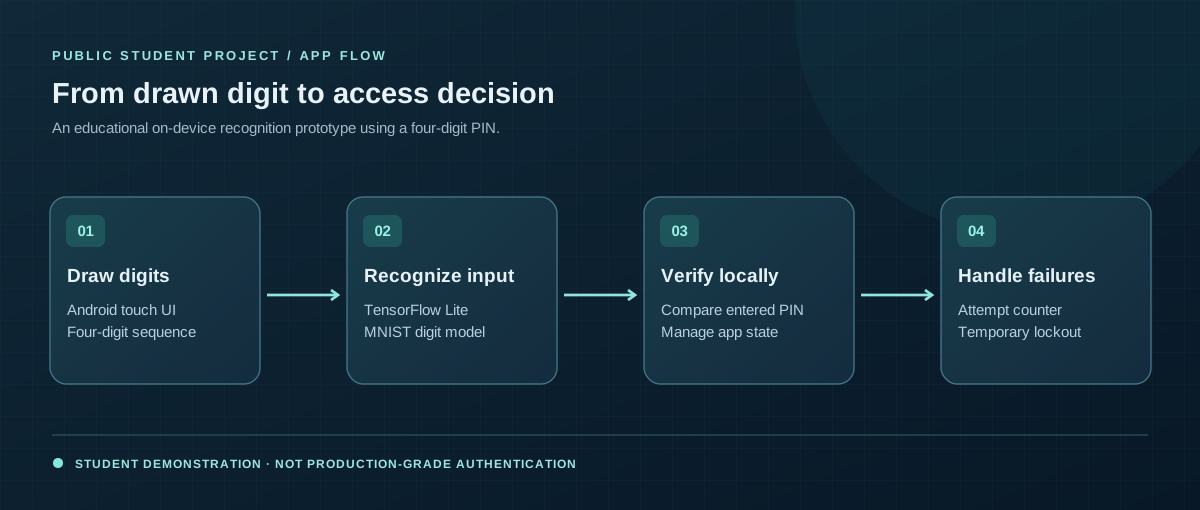
- Developed an Android user flow for drawing and confirming four PIN digits.
- Integrated an MNIST-based TensorFlow Lite model for digit recognition.
- Implemented local PIN verification with a 15-second lockout after three failed attempts.
03 / EVIDENCE
Outcomes & contribution
- Delivered a functioning educational Android application with a machine-learning inference component.
- Demonstrated the interaction between UI design, application state, and security controls.
- Published a repository with setup and execution instructions.
04 / TAKEAWAY
What I learned
Authentication UX, model error handling, and failure controls must be designed together. This prototype is not represented as production-grade authentication.
Sharing & confidentiality
Public student project. Repository is accessible below.