02 / FEATURED CASE STUDY · 2026
Cyber Deception & Detection Engineering
A separate MITRE internship project in cyber deception, presented without unpublished implementation details.
01 / CONTEXT
The challenge
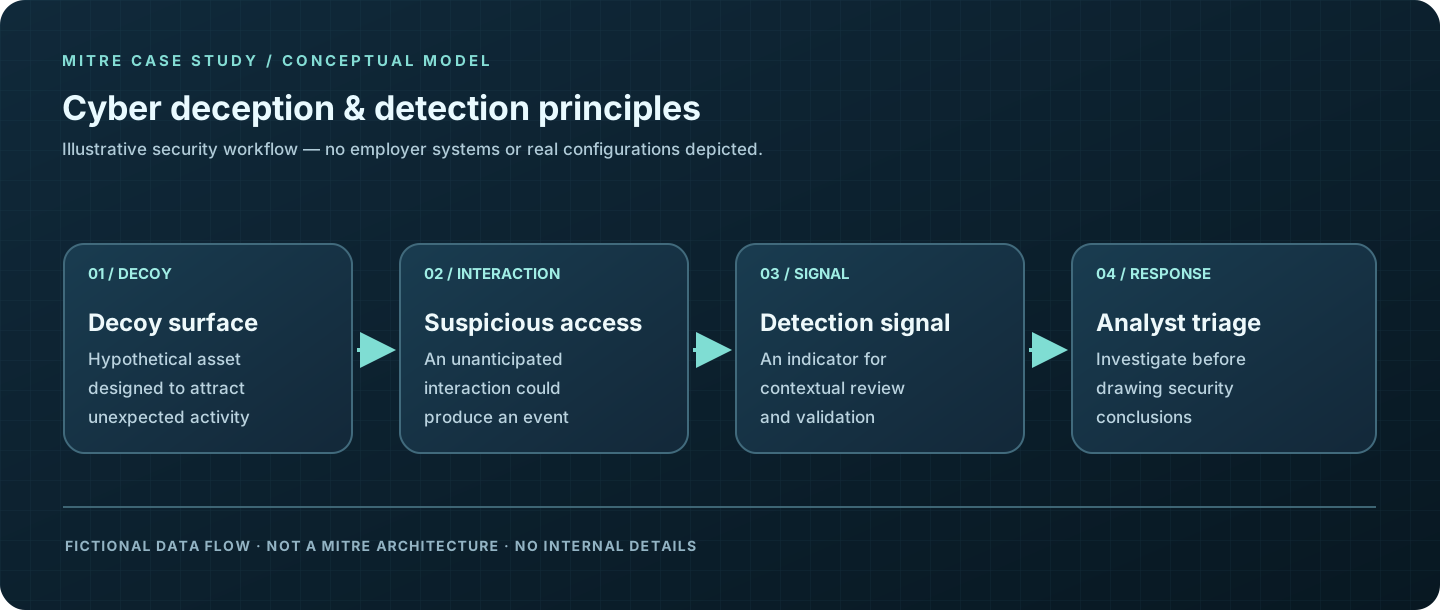
Deception-based detection raises a useful security question: how can unexpected interaction with a decoy-like surface help defenders recognize activity that merits investigation?
02 / EXECUTION
My approach
- Participated in a separate cyber deception project during my MITRE Cyber Joint Operations internship.
- Use an original, hypothetical diagram to explain how a decoy interaction might become an analyst-reviewed detection signal.
- Do not represent that hypothetical flow as the actual MITRE project design or claim undisclosed tooling.
03 / EVIDENCE
Outcomes & contribution
- Cyber deception was a distinct project area during the internship, separate from my AstraZeneca Microsoft Defender work.
- This public summary demonstrates the security problem and a generic defensive workflow, not an employer-specific deployment.
- Specific technical deliverables and measured outcomes are intentionally omitted from this public summary.
04 / TAKEAWAY
What I learned
In a conceptual deception model, interacting with a decoy is a potential lead rather than proof of malicious intent; context and validation matter.
Sharing & confidentiality
This separate MITRE internship project is summarized at a high level. This original diagram is purely conceptual; no actual MITRE assets, workflows, rules, investigation data, or performance metrics are disclosed.